
Choosing between a 4×2, a 6×4 and an 8×4 dump truck is the first decision most importers make, and it shapes everything that follows: how much each trip carries, which roads the truck can handle, and what it costs to run. For heavy-duty work, the 6×4 vs 8×4 dump truck decision is usually the hardest part. The three configurations look similar at a glance, yet they are built for different jobs.
This guide explains what the numbers mean, compares the three configurations side by side, and gives you a short checklist to match the truck to your payload and your roads.
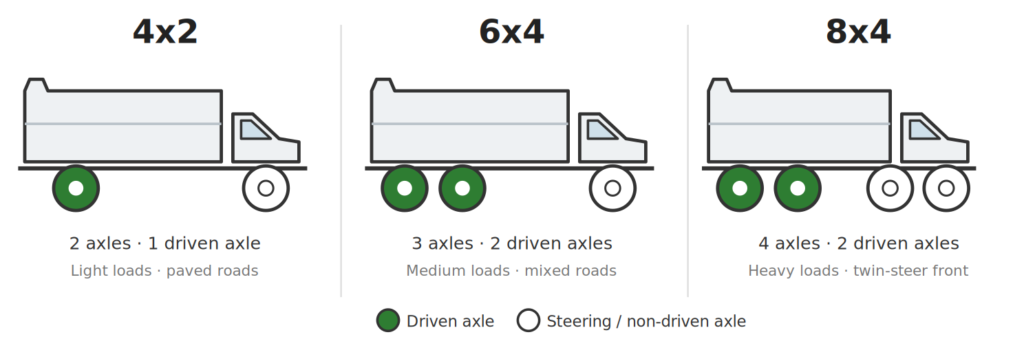
What Do 4×2, 6×4 and 8×4 Mean?
The numbers describe the axles. The first number is the total number of wheel positions on the truck, and the second is how many of them are powered. A 4×2 has two axles and one driven axle. A 6×4 has three axles, with two rear axles driving. An 8×4 has four axles, with two rear axles driving and two front axles steering.
More axles spread the load over more wheels, which is why payload rises with the configuration. More driven axles give better traction on soft or unpaved ground. The trade-off is cost: each extra axle adds weight, purchase price, tire wear, and maintenance.
| Configuration | Axles | Driven axles | Typical use | Payload |
|---|---|---|---|---|
| 4×2 | 2 | 1 | City construction, paved roads, lighter loads | Lowest |
| 6×4 | 3 | 2 | Heavy-duty work, rough roads, quarries | Medium to high |
| 8×4 | 4 | 2 | Mining, large quarries, maximum-capacity hauling | Highest |
Payload figures vary by model, body size, and your country’s legal weight limits, so treat the table as a guide, not a specification.
The 4×2 Dump Truck: Light, Cheap to Run, Easy in Cities

The 4×2 is the lightest and cheapest dump truck of the three. With only two axles it turns tightly, fits on narrow city streets, and costs less in tires and maintenance than a 6×4 or 8×4. It suits customers who run mostly on paved roads and carry lighter loads, such as urban construction, municipal work, and short-distance transport.
A 4×2 dump truck suits cities where road access is tight and weight limits are low. It is easy to drive, easy to park, and easy to service. If most of your work is in town and your loads are moderate, a 4×2 saves money every day.
The limit is traction and capacity. One driven axle struggles on soft ground, steep unpaved climbs, and heavy loads. It is not the right tool for mining or rough quarry work, and it will carry less per trip than a 6×4 or 8×4.
6×4 vs 8×4 dump truck: The 6×4 All-Rounder Most Buyers Choose

The 6×4 is the most popular heavy-duty configuration in the export trade. Two driven rear axles give strong traction on unpaved roads, while three axles keep the truck more compact and easier to turn than an 8×4. It is the standard choice for construction, infrastructure, and quarry work.
A 6×4 dump truck is the standard choice for heavy-duty work that is not extreme. Common engine options on HOWO 6×4 models are 336HP, 371HP, and 400HP and higher; SHACMAN models commonly offer 336HP, 375HP, 380HP, and 400HP and higher. More horsepower helps on steep climbs, but traction and payload matter more than power alone.
When buyers ask us about 6×4 vs 8×4 dump truck options, the 6×4 is usually our first suggestion — unless the job clearly needs the extra axle. It carries enough for most sites without the extra tires, weight, and cost of an 8×4. If your roads are rough but your loads are normal construction material, start here.
The 8×4 Dump Truck: Maximum Payload for the Hardest Jobs

The 8×4 carries the most of the three. Four axles spread a heavy load over more wheels, which also makes the truck more stable when loading and tipping. It is built for mining, large quarries, and long, high-intensity operation where every trip must carry as much as possible.
An 8×4 dump truck suits mining and other heavy work where payload is the deciding factor. Common engine options are 400HP and higher, and body sizes of 30 m³ to 35 m³ are typical, although the exact figure depends on the material and the destination market. For new trucks, the body can be customized in size and steel thickness.
The cost is real: more tires to replace, more parts to maintain, and a higher purchase price. An 8×4 also needs more room to turn. Buy it when the extra payload earns its keep every trip. If it does not, the 6×4 will do the same job for less money.
How to Choose: A Five-Step Checklist
Work through these five questions before you order. They are the same questions we ask every buyer.
1. What do you haul, and how much per trip? Sand and soil are light for their volume, while rock and ore are heavy. A lighter material may fit a 4×2 or 6×4, while rock, ore, and mine waste need a 6×4 or 8×4 to carry enough per trip.
2. What are your roads like? Paved city roads suit a 4×2. Unpaved site roads, soft ground after rain, and steep climbs call for a 6×4 or 8×4. Traction matters more than horsepower on a muddy site road.
3. What does your country allow? Axle-load limits and gross vehicle weight rules differ by market. An 8×4 that is legal in one country may be overweight in another, so check the rules before you order.
4. Which emission standard do you need? JD Truck can supply Euro II, Euro III, Euro IV, and Euro V options, depending on the model and your destination. Some markets restrict older emission levels, and the wrong standard can block registration at the port.
5. New or used, and what condition? A used truck costs less upfront and can start earning sooner, but only if it was checked properly. At JD Truck, every used truck goes through the same preparation before delivery: careful selection, key-component inspection and replacement, full debugging, and a complete inspection. Engines are refurbished where needed, and tires are changed to new tires or used tires in good condition. Ask to see inspection photos and a video of the exact truck, including the engine running and the body lifting, before you pay.
For a fuller introduction to the vehicle itself, read our guide What Is a Dump Truck?. The full range is on the JD Truck dump truck page, and the About JD Truck page explains how the company selects and prepares its trucks.
Common Mistakes When Choosing a Configuration
The most common mistake is buying the biggest truck by default. An 8×4 that hauls light loads on paved roads wastes fuel, tires, and money, and it is harder to park and turn than a 6×4. A second mistake is the opposite: buying a 4×2 for rough quarry work, then finding it cannot climb or carry enough per trip. Match the truck to the worst road it will run on every day, not the best one.
A third mistake is forgetting the body. For new trucks, body size and steel thickness can be customized. Rock and ore wear a body faster than sand, so a thicker floor pays for itself.
Frequently Asked Questions
What is the difference between 6×4 and 8×4 dump trucks?
A 6×4 has three axles and an 8×4 has four. The 8×4 carries a higher payload and is more stable when loading and tipping, while the 6×4 costs less to buy and run and turns more easily.
Which is better for mining: the 6×4 vs 8×4 dump truck?
For mining and large quarries, the 8×4 is usually the better pick because it moves more material per trip and handles long, high-intensity operation.
Can a 4×2 dump truck work on unpaved roads?
It can on firm, dry, semi-paved surfaces, but a single driven axle has limited traction on soft or muddy ground. For daily work off the paved road, choose a 6×4.
How much can each configuration carry?
Payload depends on the model, the body size, and your country’s legal weight limits. As a rule, an 8×4 carries more than a 6×4, and a 6×4 carries more than a 4×2.
What emission standard should I choose?
Euro II, Euro III, Euro IV, and Euro V options are available. The right choice depends on your destination market, so check your country’s import and registration rules first.
What should I check on a used dump truck before buying?
Request current photos and a video of the exact truck. Check the frame for cracks, the body floor for wear, the tires for remaining tread, and the hydraulic cylinder for leaks. Ask what was inspected and replaced, and ask to see the engine running and the body lifting.
Conclusion
The 4×2 is the cheapest and easiest to run, the 6×4 is the all-rounder that fits most jobs, and the 8×4 is the maximum-payload tool for mining and heavy quarry work. The right choice is the smallest configuration that still carries your heaviest load on your worst road. That is why the 6×4 vs 8×4 dump truck decision should come down to payload per trip and the roads you run every day, not to size alone.
If you are planning your next order, talk to JD Truck first. Send your material, daily volume, road conditions, and destination port, and the team will reply with a quotation, real photos, and a video of the truck. Email info@jdtruck.com or WhatsApp +86 157 9568 9611. JD Truck is based in Liangshan County, Jining, Shandong, China.